
In Tuesdays class we did an exercise where we made a mind map of the work we have done so far and where we plan to go from here.
I began by noting down significant steps for each week:
Week 1 – I really liked the vibrancy of the wall surrounding the St. James Theatre and the complexity of the design painted on the surface. The more you looked the more you uncovered.
One of the first models I created in week one used organic shapes that were the cutoffs from another model. The unique and unplanned shapes created a few different options for putting together a model.
Week 2 – When reflecting back on the cupcake models I noticed I consistently used a mix of bright colours and layered them in a way which created some interesting and fun reflections.
Week 3 – The colour theory presentations made me consider the emotions and experiences that use of different colours can create and how I could use something similar in my work to achieve desired effects in the viewer.
After visiting the site I started thinking how I would like the space to be used and the feeling I wanted to create in this old rundown building.
Week 4 – I would say week 4 was a turning point for me in this project.
I chose Liz West as my artist model as I was drawn to her bold use of bright colours and lighting in her installations. Her work comes across as bright, playful, youthful, multidimensional and transformative. The spaces she creates are inviting, vibrant and create a joyful experience which are all things I want to try and put into the St. James Theatre.
From the artist model workshop I noticed the reflective qualities, colour and structural quality of models I made. The inspired me to create an intervention that can be moved through and experienced with the whole body instead of just the eyes.
Week 5 – When looking closer at everyday surfaces I began to notice that even the simplest of materials can have some great qualities depending on perspective, time of day, location and other surroundings. The more ‘boring’ surfaces became my favourite after looking at them through a different lens.
Week 6 – When developing my intended surface I was able to look back at what had influenced me and what key elements I wanted to bring into the design.
After noting down the key discoveries from each week I began to think more specifically about my design and how I wanted it to come to life using these elements.
What can be used going forward – Use of extruded forms that interfere/obstruct the monotonous daily flow of pedestrians and transform the dark and dull foyer into a space with character.
What is the intervention – Extruded surfaces (created by tracing over a paint splattered surface) that mould around each other, coming down from the ceiling at various heights. They’re large and exaggerated and through the use of lighting and bright colours they transform the space into a playful and inviting environment that people will want to use. The space will function as a passage way and the surfaces will impede to certain degrees on the users of the space whilst still allowing it to function efficiently.
Who is the viewer – Anyone and everyone can use this space. It is intended as a passage way between Queen and Lorne Street that gives users the opportunity to brighten up their day with something a bit different than the dirty grey city streets. It is suitable for people of any age and a wide range of mobility. There are steps on the Queen Street end so if a wheelchair user was to visit the space they would be unable to use both entrances.
How will they use it – A passageway between Queen and Lorne Street, a unique space that offers some respite from the usual grey pavements of the city. It is a place to explore and experience and hopefully feel uplifted.
What will they need – Nothing is needed to use this space
What will they experience – As you move through the space you weave around the unique extruded forms (They are all varying heights. Some are floor to ceiling but most can be moved under with ease) and if you pause to look up a while you’ll see a sort of moulded puzzle created by the shapes. A warm and inviting space flooded with colour and light, creating a joyful and uplifting experience.
I then simplified these notes down into a simple mind map listing the most important points.
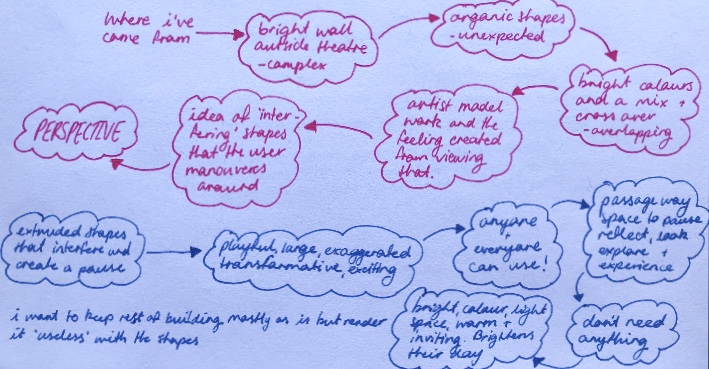
The first mind map was focused more on visual elements of the design so I then made another which was more conceptually focused.
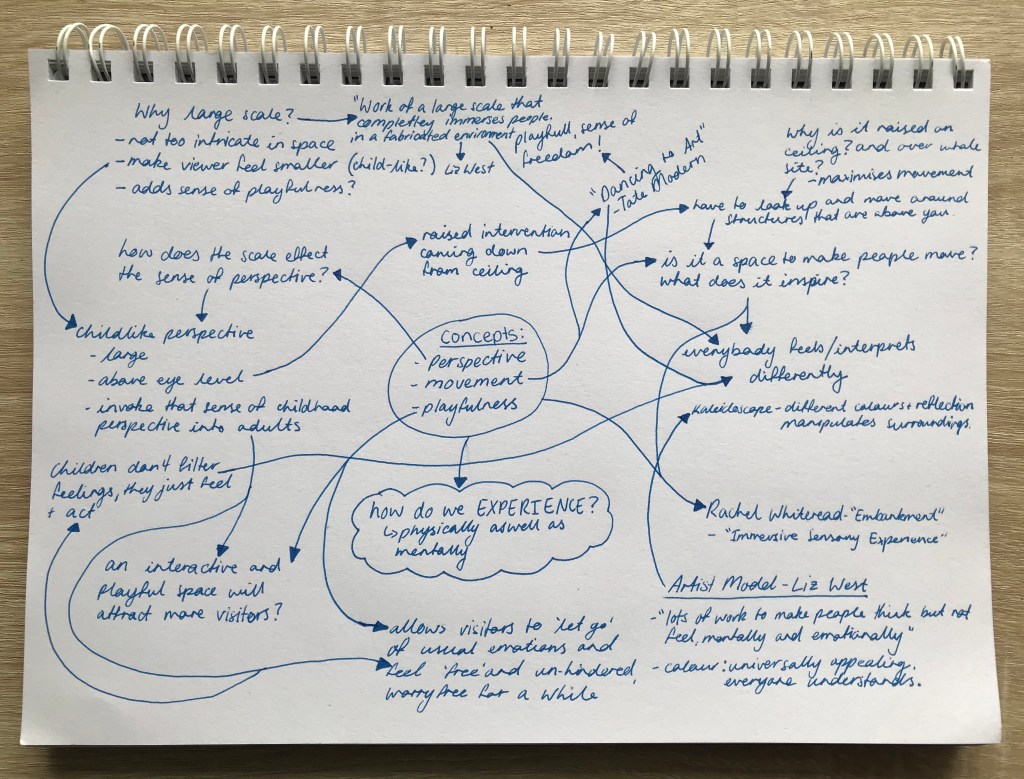
A key moment in this project for me was a video I saw on the Tate Modern website titled Dancing to Art. In this video different dancers choose a piece of art within the Tate galleries and take a moment to interpret it. They then turn that interpretation into movement – interpreting the artworks through dance. This video made something click for me and really inspired me with the direction of my work. After seeing this I began to think of how users might interpret my intervention and if I wanted to try and construct a certain interpretation for them or create a space which would leave it entirely up to them.
Link to Dancing to Art video: https://www.tate.org.uk/visit/tate-britain/dancing-art
Initial Abstract:
Situated in the heart of the city with a near constant flow of working professionals, students, tourists and locals, the St. James Theatre has sat, overlooked and unused for years, a far cry from its previous life as a key player on Auckland’s social scene. (project name) aims to reintroduce this historic landmark back into the daily lives of Aucklanders by the way of a unique alternate passageway connecting Queen Street and Lorne Street.
The space, a world away from the dull city streets, is a colour and light filled area cut through by a series of large structural forms, moulded around themselves and extending down from the ceiling creating a maze-like landscape through which city dwellers can explore. The bright and bold colours and lighting are influenced by installation artist Liz West, specifically her works “Our Colour Reflection” and “Through no. 3”. West creates vibrant spaces that feel playful, inviting and transformative of the original sites. I am inspired to bring similar values and qualities into the St. James Theatre through my own design.
Throughout this process, an important aspect I wanted to focus on was perspective. I want the space to feel playful. I don’t mean this in a childish sense that I want people to run around and literally play in the space, but more that I want the space to ignite this feeling within the viewer. To make the viewer feel this sense of childlike exuberance compared to the way they would feel walking the city streets in the surrounding area. When thinking about how I could incite this reaction in people I thought that perhaps looking at things from a Childs perspective would help. When you’re a child and you’re smaller than most of the built environments around you, you are constantly looking up at the world and everything seems so exaggerated and exciting. Through placing my surface on the ceiling of the space with it extending downwards I was able to mimic this sense of childlike perspective for any user of the space, child or adult alike. My hope is that through this perspective the installation is able to stir up the same sense of simple, childlike happiness in the viewer. It also serves as a reminder to look up every once in a while and take in the world, to not be absorbed by what’s in front of you or your phone or busy rushing from one place to another. It’s a reminder to slow down, breath and take it all in.
The design will be modelled largely through digital media but with a combination of hand modelled details.
 Spatial Design
Leave a comment