
Abstract: Situated in the heart of the city with a near constant flow of working professionals, students, tourists and locals, the St. James Theatre has sat, overlooked and unused for years, a far cry from its previous life as a part of Auckland’s social scene. My aim is to reintroduce this historic landmark back into the daily lives of Aucklanders by the way of a unique alternate passageway connecting Queen Street and Lorne Street.
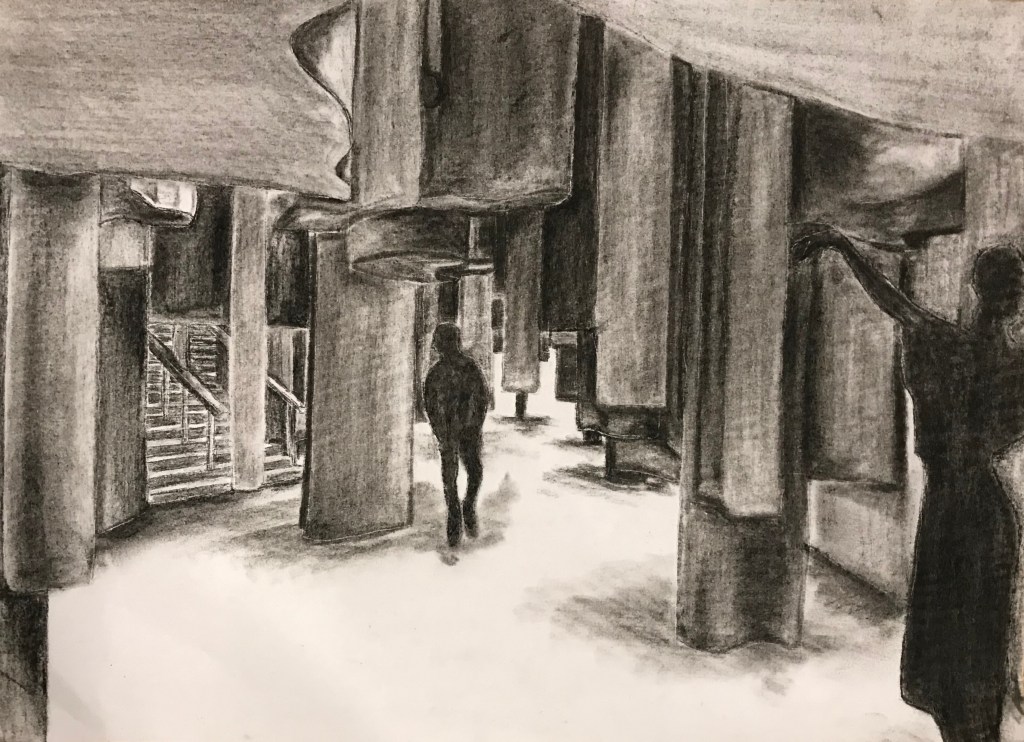
The proposed design is a colour and light filled area cut through by a series of large structural forms, moulded around themselves and extending down from the ceiling creating a maze-like landscape through which city dwellers can explore. With a key focus on movement and perspective, the space is designed to have a playful aspect igniting a sense of childlike exuberance within the viewer.
The following texts are explored and considered in relation to the key idea of movement, giving consideration to other aspects that can influence or effect movement through the space. The research aims to answer the critical question: How do people interact with space? Focusing on movement and how objects within space can alter how or why we move the way we do. Interpretation of space, movement, dance, culture, empathy and mauri are also largely considered throughout the texts.
Contextual Essay
Keywords: Universal human experience, Movement, Emotions, Empathy, Culture, Intervention, Space, Mauri
Re-imagining the St James Theatre as a passageway connecting the streets of Auckland, I began to think more intently about the way we move through a variety of day to day spaces, and what we can do as designers to influence this. It was from here that a key idea emerged: Is there a universal human experience of movement? Inspired by Dancing to Art by Tate Modern[1], I considered interpretation of space through movement and dance, the embodiment and release of emotion. Space and Place: The Perspective of Experience by Yi-Fu Tuan[2], brought me to the observe the connection between movement and culture within a space and how these can either work with or against each other. How to Encounter a Puddle by Anny Li[3] and Bad Mood: On Design and Empathy by Benjamin H Bratton[4] brought forward thoughts on how we connect to the world around us on a instinctual human level and how this can be combined with empathic design to create an emotive and moving experience. These texts were instrumental in guiding me in my work to design a passageway that would evoke emotion and movement from users of the space whilst providing a unique way of moving about the city.
Different spaces have the ability to invoke in us a unique way of moving and I find myself wondering: What is it about these spaces that gives them this potential, and how can I achieve this in my own work? In my research into the matter I came across a video ‘Dancing to Art’ produced by Tate Modern. In this video a number of dancers with learning disabilities each chose an artwork within the Tate Modern galleries to analyse and interpret through dance. The idea behind this was to show what happens when people have the freedom to enjoy the gallery space however they want, and how this can open up new ways of responding to art.[5] It is worth noting here, the power of dance, it creates the opportunity for individuals to evoke, connect, and express powerful emotions[6] and allows self-expression without the use of words, it is also highly beneficial when it comes to exploring spatial orientation. But what is it about a space or an artwork that makes us want to move in a certain way? Is it the sense of freedom in an empty room or the objects in a cluttered one that persuades us to move in a certain manner? Tuan writes that space is given by the ability to move and that movements are often directed toward, or repulsed by objects and places.[7]These texts were a key source of inspiration to me in my studio practice and how I would like to incite a similar desire for movement in those experiencing the intervention I’ve designed. Now, the form of movement might not be dance, and it might not be the same for all who use the space but the underlying idea is that it opens up the opportunity for users to interpret the design as an individual, separate from the conforms of society and how we would usually use a public space. This also allows for a range of emotions to be explored and portrayed throughout the space. The pieces of art in the Tate and the movements they give fruition to could perhaps be compared to those objects that either draw toward or repulse as Tuan mentions. They have the potential to affect the viewer on an emotional level and offer the opportunity for response through words or where words fail in this instance, movement. This interconnection of the intangible and material aspects seems to me to offer an astounding depth of possibility when designing, especially when the aim of that design is to create an emotive and moving atmosphere within a space.
Within one city there can be any number of different cultures and nationalities who have the opportunity to come into contact with a space. Alongside culture there is also the differences in age or religion within society, these things can all impact on how a person perceives and interacts with the world around them. Yi-Fu Tuan writes that culture strongly influences human behaviours and values.[8] It’s true, a sense of space can vary from culture to culture but it overlooks how we as humans, all have shared traits that have the ability to transcend cultural distinctiveness. Many cultures have strict beliefs surrounding social behaviours and etiquette but if you took culture and its individual guidelines out of the equation, we surely all have the ability (whether we follow through with it or not) to feel and then transcribe that into movement. Culture does have influence on behaviour of course, but so does being human. This brings me to consider Anny Li’s writing How to Encounter a Puddle where she makes a note about how puddles can make us pause or prompt us to action.[9] If we were to imagine the puddle here as the designed space and its reactionary movements, to pause or to prompt, then the effect of the space could be considered in relation to those cultures or age group coming into contact with it. For arguments sake I’m going to assume that children, no matter which culture they’re raised in are going to see this puddle and want to react and play, splash and explore within its depths. However those from an older age group and perhaps those bound to certain cultural norms would potentially have quite a different reaction to the puddle. My point is that as children, we act often without thinking and therefore our movement is more free, it could be considered universal, something the large majority of children do. However as we age we begin to filter through these desires more rationally and thus hinder our emotive movement through the spaces and day to day experiences we encounter.
Perhaps when thinking about what it is in a space that has the ability to create a universal effect of movement we should begin to think about the space on a more holistic level. Is it the mauri, the life force or feeling of a place, that we connect to and thus move accordingly? Firstly, I think it is important to recognise that no two people are the same and so their emotions and thoughts towards a space will always differ. However surely there are places in the world, perhaps such as historical sites and landmarks, that have the ability to really make you feel an emotional connection, no matter your background. Connecting to people’s emotions – which are intangible- can be difficult to do through a built material environment such as the intervention I have designed for the St James Theatre. Bad Mood: On Design and Empathy by Benjamin H Bratton[10] was a text I turned to hoping to gain some perspective on empathic design. To have empathy is to be able to share and understand the feelings of another. It connects us emotionally to the world and people around us by allowing us to put ourselves in the experience of one another. Bratton discusses the possibility of moodless design and if it is in fact possible to create something that doesn’t provoke any sort of mood.[11] Whilst I find his thoughts on the topic of moodless design very interesting I want to focus on the designs done empathically that have the opposite effect, the designs that make us feel and contribute to the mauri of a space. This brings me to consider another text, Radical Interiority: Playboy Architecture 1953-1979 by Beatriz Colomina. In a section of the text Colomina makes reference to how the layout and equipment of the apartment are a part of the choreography of seduction. The details and designs of the furniture are said to assist in the movement of bodies through the apartment space.[12] When looking into the designs mentioned its clear to see the connection, the enveloping shape and smooth, curved edges assisting in a sinuous flow through the space. Perhaps when looking at movement through spaces we can’t pick out a singular aspect that encourages said movement but rather that each space needs to be designed individually to illicit whatever response. The objects within a space don’t matter so much as the feeling, the mauri, created within the space itself.
The assigned readings throughout this semester and the above texts referenced, have greatly helped me as I strived to create a design that incorporates my key design ideas whilst keeping the space cohesive. As the main idea I’m exploring is the possibility of a universal human experience I believe one of the most effective ways of achieving this is through designing on a human level. Through the use of empathic design its seemingly possible for people to connect to the space on a personal level and interpret the space as they wish. Alongside this, empathic design has the ability to influence us on a subconscious level, giving designers another element that can be used in helping govern the movement of people through the intervention. That each user will view the space differently is inevitable due to a variety of cultures that will be likely to utilise the intervention. However being aware of this produces an opportunity to delve deeper and design an intervention that potentially could appeal to the basic human instincts above and beyond individual cultures.
Bibliography
- Tate. (2019) Dancing to Art. Retrieved from: https://www.tate.org.uk/visit/tate-britain/dancing-art
Date accessed: 23/05/2020 - Dyck, E & Burger, B & Orlandatou, K. (2017). The Communication of Emotions in Dance. Retrieved from: https://www.researchgate.net/publication/313718936_The_Communication_of_Emotions_in_Dance
Date accessed: 01/06/2020 - Tuan, Y. (2018). Space and place. Minneapolis: University of Minnesota Press.
- Li, A. (2018) How to Encounter a Puddle. Retrieved from: https://volume-1.org/Triple-Canopy-How-to-Encounter-a-Puddle
Date accessed: 01/05/2020 - Bratton, B. (N.D) Bad Mood: On Design and ‘Empathy’. Retrieved from: https://arena-attachments.s3.amazonaws.com/871517/598e1a07aff70f4a49439da60eb4efe8.pdf?1486526575
Date accessed: 01/05/2020 - Colomina, B. (2015) Radical Interiority: Playboy Architecture. Retrieved from: http://volumeproject.org/volume-33-beatriz-colomina-radical-interiority-playboy-architecture-1953-1979/
Date accessed: 04/04/2020 - Image 1: Gurney, J. (2020) Proposed Intervention for St James Theatre. [Charcoal on paper] Auckland.
[1] Tate. (2019) Dancing to Art. Retrieved from: https://www.tate.org.uk/visit/tate-britain/dancing-art
[2] Tuan, Y. (2018). Space and place. Minneapolis: University of Minnesota Press.
[3] Li, A. (2018) How to Encounter a Puddle. Retrieved from: https://volume-1.org/Triple-Canopy-How-to-Encounter-a-Puddle
[4] Bratton, B. (N.D) Bad Mood: On Design and ‘Empathy’. Retrieved from: https://arena-attachments.s3.amazonaws.com/871517/598e1a07aff70f4a49439da60eb4efe8.pdf?1486526575
[5] Tate. (2019) Dancing to Art. Retrieved from: https://www.tate.org.uk/visit/tate-britain/dancing-art
[6] Dyck, E & Burger, B & Orlandatou, K. (2017). The Communication of Emotions in Dance. Retrieved from: https://www.researchgate.net/publication/313718936_The_Communication_of_Emotions_in_Dance p.123
[7] Tuan, Y. (2018). Space and place. Minneapolis: University of Minnesota Press. p.12
[8] Tuan, Y. (2018). Space and place. Minneapolis: University of Minnesota Press. p.5
[9] Li, A. (2018) How to Encounter a Puddle. Retrieved from: https://volume-1.org/Triple-Canopy-How-to-Encounter-a-Puddle
[10] Bratton, B. (N.D) Bad Mood: On Design and ‘Empathy’. Retrieved from: https://arena-attachments.s3.amazonaws.com/871517/598e1a07aff70f4a49439da60eb4efe8.pdf?1486526575
[11] Bratton, B. (N.D) Bad Mood: On Design and ‘Empathy’. Retrieved from: https://arena-attachments.s3.amazonaws.com/871517/598e1a07aff70f4a49439da60eb4efe8.pdf?1486526575
[12] Colomina, B. (2015) Radical Interiority: Playboy Architecture. Retrieved from: http://volumeproject.org/volume-33-beatriz-colomina-radical-interiority-playboy-architecture-1953-1979/
 Spatial Design
Leave a comment