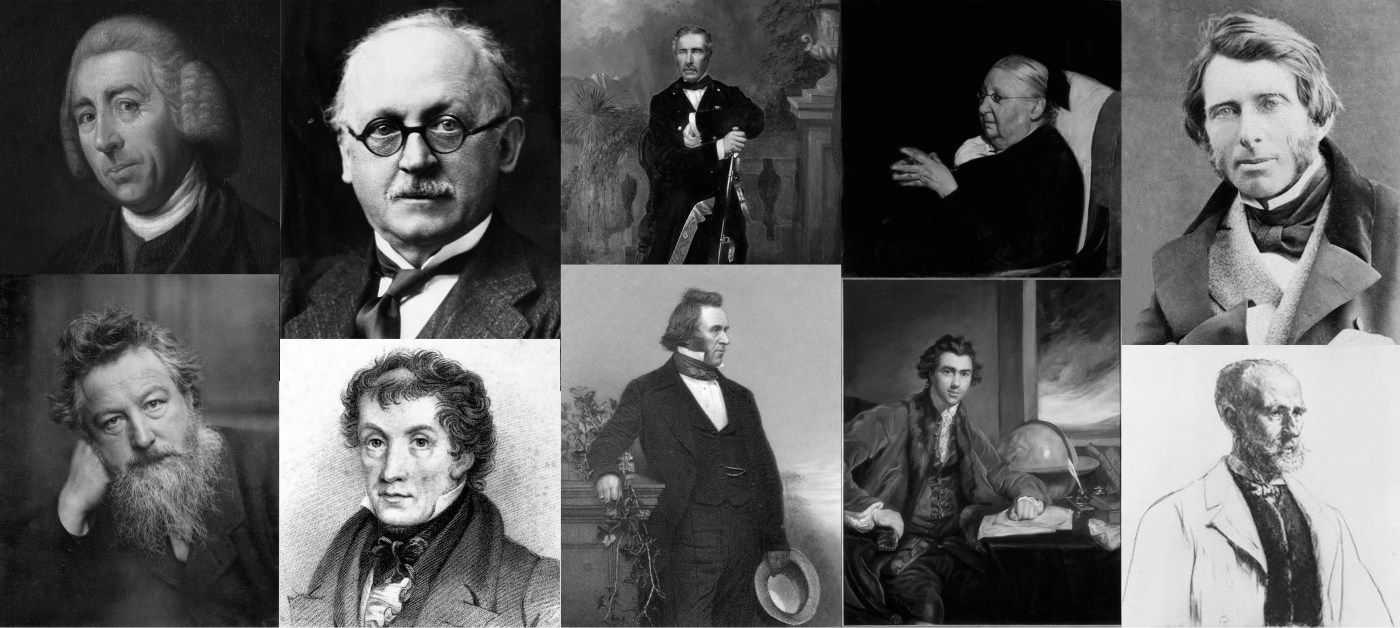
Joseph Banks 1743-1820
- British naturalist, botanist and patron of natural sciences
- Encouraged King George III to support voyages around the world
- HMS Endeavour visiting Brazil, Tahiti, NZ and Australia collecting new specimens
- Wrote detailed descriptions while plants were fresh (illustrator sketched them at the same time) then placed in folded sheet in sun to dry
- Found many new specimens not know to European science
- “Account of New Zealand” details his visit and the almost 400 specimens he found (almost all new)
- President of Royal Society over 41 years
- Advised King George III on Kew Gardens and sent botanists around world to collect specimens
- Credited for bringing 30,000 plants specimens to the UK (of these he found around 1,400)
- Believed in internationalism of science
- Advocated British settlement in NSW
- advised British government on Australian matters
- Credited for introducing Eucalyptus Acacia and Banksia (named after him) to western world
- Around 80 species of plant named after him
- Several places named after him worldwide (Banks Peninsula NZ)
Retrieved from: https://collections.tepapa.govt.nz/object/381640
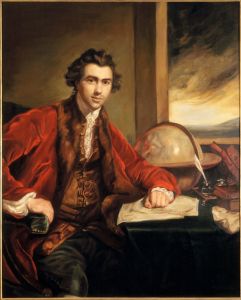
Sir George Grey 1812-1898
- British soldier, explorer, colonial administrator and writer
- Trained in military, served as junior officer in Ireland, this shaped his political views
- Interested in cultures of Indigenous people after spending time in Western Australia
- Appointed Governor of NZ in 1845
- Colony nearly bankrupt and bad race relations
- Negotiated purchase of large areas of Māori land
- European settlement grew quickly
- Chief author of 1852 constitution setting up provincial and national representative assemblies
- Left to South Africa in 1853 but returned to NZ after fighting broke out in Taranaki over disputed Waitara purchase
- 1861 introduced “new institutions”- local tribal councils with administrative and judicial functions
- aimed to avoid another Waitara issue, encourage land sales and create common ground between settlers and Māori
- Invaded Waikato as they were main resistance to the land sales (his justification was that they were planning an attack on Auckland)
- Retired to Kawau Island to study ethnography (scientific description of peoples and cultures with their customs, habits and mutual differences) Māori lore and exotic plants/animals
- Entered NZ parliament as premier in 1877 but later was forced to resign
- Reputation ruined by policies in Taranaki, invasion of Waikato and confiscation of Māori land
- Confiscations caused decades of trouble
Retrieved from: https://nzhistory.govt.nz/media/photo/george-grey-painting
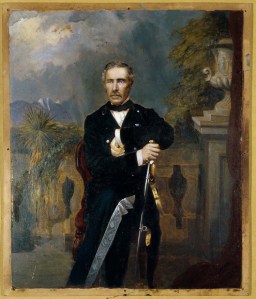
Joseph Paxton 1801-1865
- English landscape gardener and hothouse designer
- Designed many glasshouses, eclectic houses and public park layouts
- Started as a garden boy at age 15 at Battlesdon Park, moved to Chiswick Gardens in 1823
- Architect of Crystal Palace for great exhibition of 1851 in London
- From 1826 he was superintendent of gardens at Chatsworth (at 20 years old)
- Here he built famous iron and glass conservatory (1840) and lily house for the rare Victoria Regia (1850)
- Redesigned the gardens and became skilled at moving mature trees
- Knighted for work of Crystal Palace (although the structure wasn’t seen as revolutionary in style until later)
Crystal Palace: International competition to design building to house exhibition. Of 245 entries only two were remotely suitable and both would take too long to build and be too permanent. The exhibition was to be held at Hyde Park and there was uproar at the park being destroyed.
After mentioning to a colleague he had an idea Paxton was encourage to put forward plans (within 9 days) so he sketched ideas in meetings (first sketch inspired by the Victoria Regia glasshouse at Chatsworth)
He presented plans to the commission then by-passed them and had the plans published in Illustrated London. He received universal acclaim.
Crystal Palace was a modular, prefabricated design and the amount of glass made it unique. It was only possible due to advancements made in the manufacturing of glass and cast iron and also a tax drop on glass.
It was quick to build, taking 6 months. Contained 4,500 tonnes of iron, 60,000 sq. ft timber and over 293,000 panes of glass.
The building was moved to Sydenham where it remained until a fire in 1936 which destroyed it.
Sir Joseph Paxton
Retrieved from: https://www.britannica.com/biography/Joseph-Paxton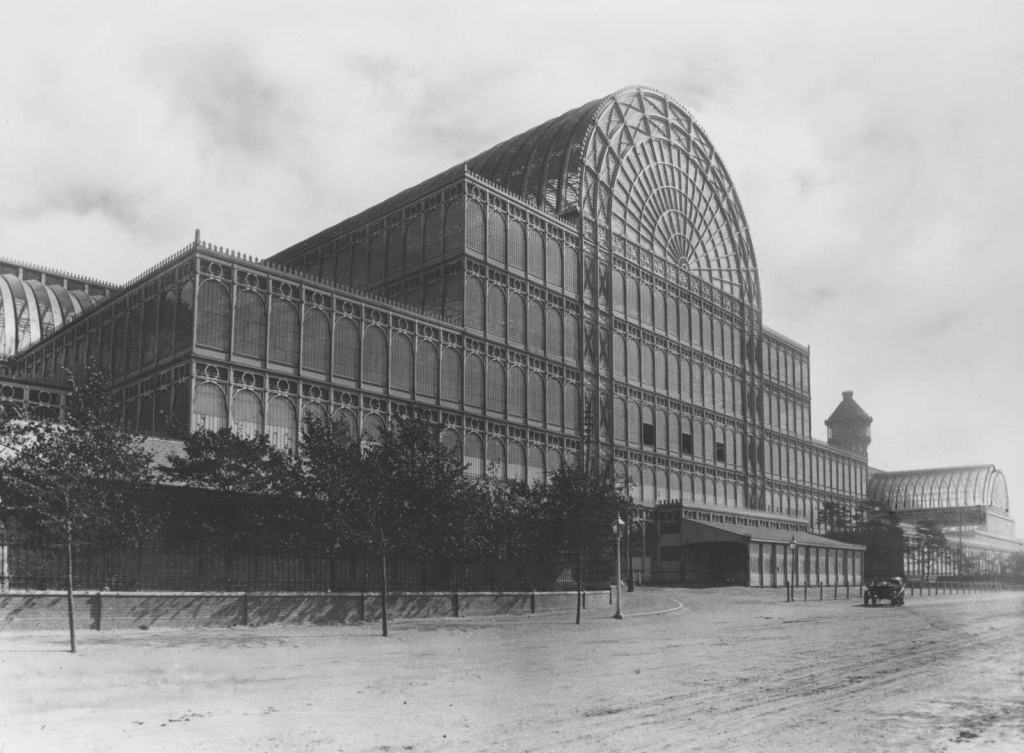
The Crystal Palace at Sydenham Hill, London
Retrieved from: https://www.britannica.com/biography/Joseph-Paxton
John Claudis Loudon 1783-1843
- Scottish landscape gardener and architect
- Most influential horticultural journalist of his time
- Writings helped shaped victorian taste in gardens, parks and domestic architecture
- Wrote and publish “The suburban gardener” with his wife which set style for smaller gardens of the growing middle class
- Advocated irregular, picturesque gardens that were also used for botanical study
- referred to his style as gardenesque (he was anti-picturesque)
- Centre of his approach is the arboretum
- Involvement in architecture came from interest in landscapes
- Consciously aimed at middle class helping shape victorian suburban architecture
- Consciously aimed at middle class helping shape victorian suburban architecture
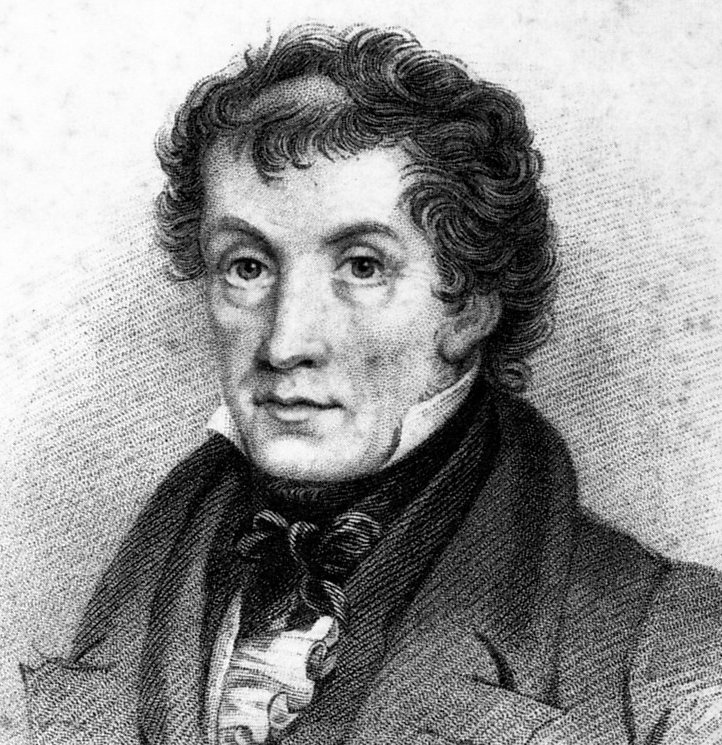
John Claudis Loudon
Retrieved from: https://en.wikipedia.org/wiki/John_Claudius_Loudon#/media/File:John_Claudius_Loudon.png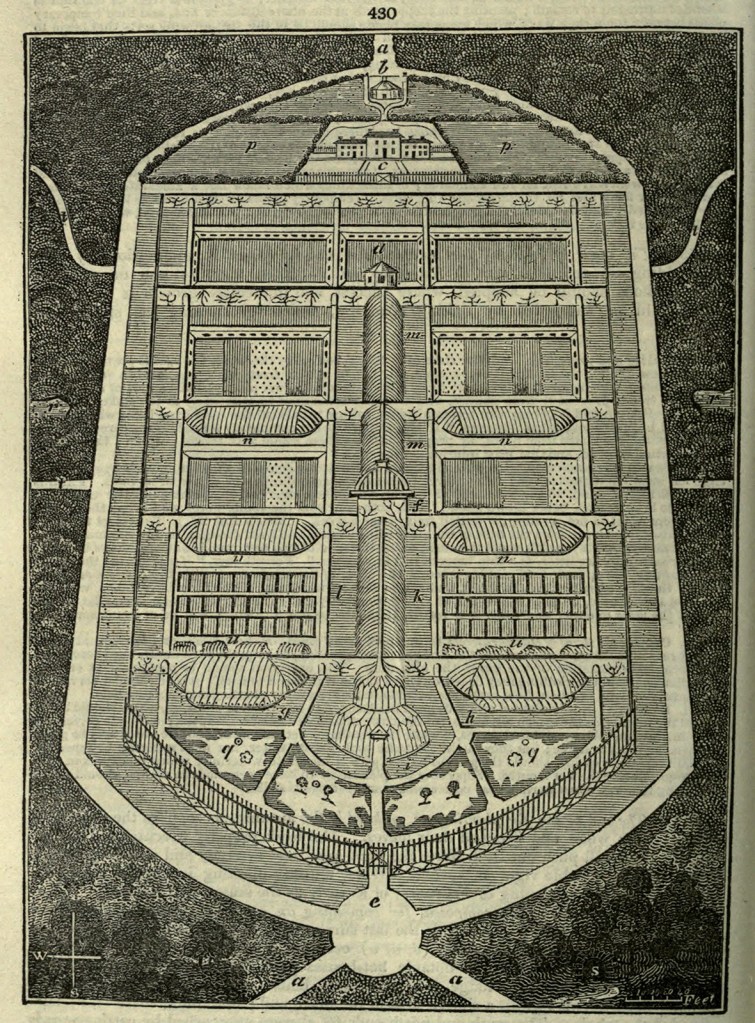
Plan for an extensive kitchen garden, with flower garden, hot houses, orchards, and gardener’s lodge and offices, in An Encyclopaedia of Gardening by John Claudius Loudon, 1828 edition
Retrieved from: https://www.britannica.com/biography/John-Claudius-Loudon
William Robinson 1838-1895
- Irish gardener and horticultural writer
- Studied horticulture at National Botanic Gardens near Dublin
- Moved to London in 1861 and worked in Regents Park
- Wrote his first gardening book in 1867
- Criticising the formal nature of French gardens
- Praising the natural style of ‘sub-tropical’ bedding
- Aversion to straight-laced garden design and thought the industrial revolution was putting nature at risk
- Influenced by Arts and Craft movement
- Against poor design and mass production as a result of industrial revolution and wanted to bring back traditional handcrafted designs
- Friends with Gertrude Jekyll as they shared the same beliefs in regards to gardening
- Published two books in 1870, “Alpine Flowers for Gardens” and “The Wild Garden”
- Alpine Flowers proposed planting species of alpine flowers in small rock gardens which quickly caught on and became common place in many English gardens
- Wild Garden said a garden should encourage natural development and have respect for plant form, colour, growing habits and foliage rather than a strict layout
- Concept of permanent planting instead of bedding plants and insistence on an informal garden by mixing native and exotic plants, patches of bulbs in grass and subtle use of colour
- Important in changing gardening into what we know and are familiar with today
- Launched a weekly journal in 1871 called “The Garden”
- Allowed him to reach a wide audience and convey his naturalistic approach using trees, rocks, water and pasture together with more readily available plants which set the style for large gardens
- “The English Flower Garden” in 1883 encouraged each person to be individual in their own gardens and to study the interactions of plants, looking at size, shape and foliage and how they work with or against each other
- Wanted to leave gardening to each persons imagination with the ability to create a personal garden
- Examples of Robinsons work can be seen at Gravetye Manor (his own house, now a hotel)
- Gardens at Hergest Croft, Emmetts Garden and Killerton were strongly influence by Robinson
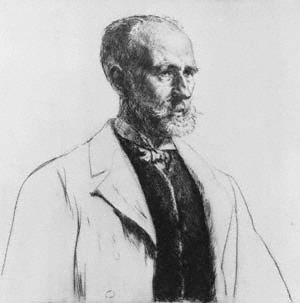
Dodd, F. William Robinson
Retrieved from: https://www.oxforddnb.com/view/10.1093/ref:odnb/9780198614128.001.0001/odnb-9780198614128-e-37906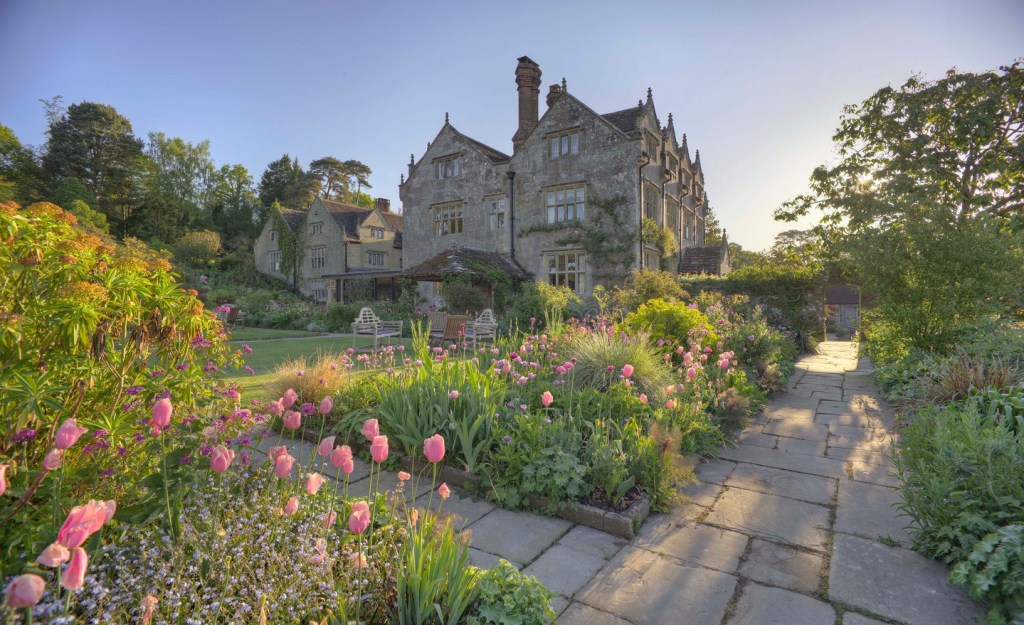
Gravetye Manor
Retrieved from: https://www.greatbritishgardens.co.uk/garden-designers/38-william-robinson.html
John Ruskin 1819-1900
- Influential Englishman best known as an art critic and patron but also a water-colourist, teacher, geologist and campaigner for social and political change
- Religious upbringing in rural London impacted on Ruskins ideas and he believed nature and beauty were tied to concepts of The Divine
- Argued best way to portray faith wasn’t through religious scenes but through understanding and faithful depictions of nature and the human body
- The importance of nature, god and society are a running theme through much of his work and helped form his forward thinking beliefs
- Identified risks to come from the industrial revolution before they had happened (such as pollution and its effects)
- Responsible for shaping and promoting Arts and Craft Movement through writings as his style of criticism was considered groundbreaking and hugely influential for generations
- An emphasis on the natural and a strong dislike of mass production
- Advocate for new painting styles, protection of historic buildings, conservation of natural landscapes, education of women and improved conditions for the working class
- Writings helped encourage the formation of the National Trust and brought new artists to attention
- Helped shape welfare reforms in Britain such as introduction of minimum wage, free school meals and universal healthcare
- Published more than 50 books on a range of topics and used simplified writing styles to make them accessible to as many people as possible
- Encouraged “truth to nature” which encouraged painters to closely observe landscape and capture what they saw as realistically as possible without romanticising
- Hugely influential on Pre-Raphaelite Brotherhood (group of artists against contemporary notions of artistic beauty who produced pre-renaissance style works)
- Promoted Gothic architecture and his writings influenced a return to the earlier gothic style from Neoclassicsim which was popular at the time
- Ideas said to be influential in the Garden City Movement (method of urban planning where self contained communities are surrounded in a “greenbelt” helping to keep a proportionate area of residences, industry and horticulture)
- An artist of nature, often including in his works blossoms, flowers, mountains, stones, clouds, minerals and birds
- “The Stones of Venice” a book Ruskin wrote about venetian architecture and art which he had a fondness for (and which helped protect the venetian architecture)
- In the chapter “On the Nature of Gothic” he proposes that architecture reveals the spiritual and moral state of the society that produced it
- Admired the christian society of the Middle Ages and its imperfections that represented individual craftsmanship and talents but also the communal art inspired by a love of God
- Against regularity and geometric shapes of classical style (to Ruskin this represented coldness, a need to control and a ‘haughty aristocratic style’
- Classical architecture represented a fall from healthy civilisation
- “Unto This Last” a book that talks about capitalist economies and dehumanisation caused by the industrial revolution and pleads for a fairer society
- Set up his own art school in 1871 which challenged formal and rigid teachings
- Founded Guild of St George (utopian society encouraging traditional crafts and amassed a large collection of art, books and historical objects)
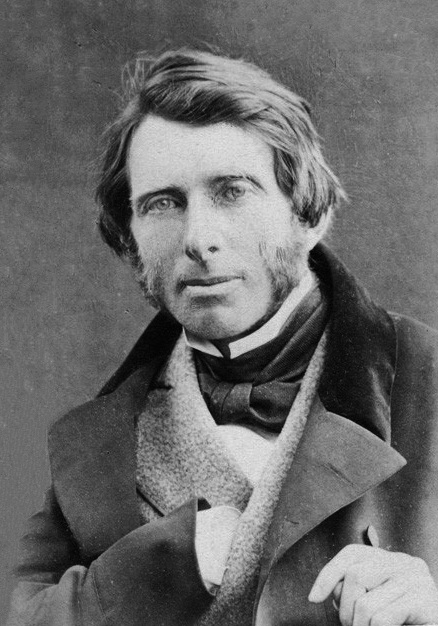
John Ruskin
Retrieved from: https://en.wikipedia.org/wiki/John_Ruskin#/media/File:John_Ruskin_1863.jpg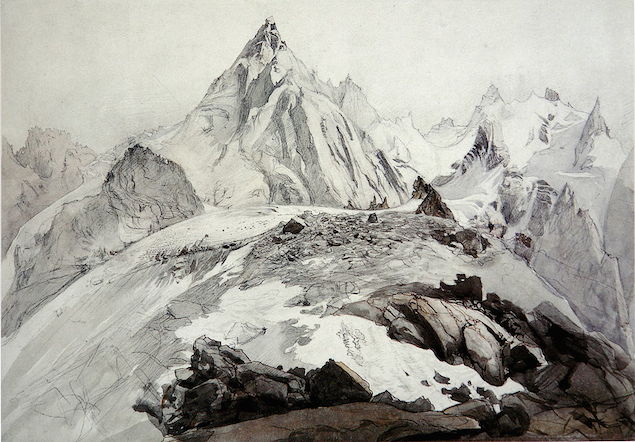
Ruskin, J. (1856) Drawing of the Mont Blanc, France
Retrieved from: https://www.theschooloflife.com/thebookoflife/the-great-philosophers-john-ruskin/
William Morris 1834-1896
- British textile designer, poet, novelist, translator and socialist activist
- Now regarded as modern and visionary thinker whos art included the whole man made environment
- Developed an affinity for landscape, buildings and historical romance
- held strong opinions on design and “craft principles” (manmade)
- Introduced to The Pre-Raphaelite Brotherhood at Oxford
- The brotherhood gave him an awareness of the deep divide in contemporary society which sparked and interest in trying to create and alternative to the ‘dehumanising industrial systems producing poor quality and un-natural objects’ (very John Ruskin sounding…)
- Began working in office of leading neo gothic architect George Edmund Street in 1855
- Left this position after 8 months to become an artist
- Worked with Dante Gabriel Rossetti (member of the Brotherhood) painting murals at the Oxford Union
- Wanted to realise his dream of a craft-based artistic community
- Began this by building his own family home using architect Philip Web
- Red house was a ‘medieval in spirit’ property that would eventually be able to accommodate more than one family
- The home was furnished with help from member of his artistic circle (he wasn’t happy with anything on offer commercially) They created huge murals and hand embroidered fabrics resulting in the home feeling like an old manor house.
- Began this by building his own family home using architect Philip Web
- After the success of their joint work they set up their own company in 1861 – Morris, Marshall, Faulkner and Co.
- Everything handmade (became hallmark of career)
- Became known for stained glass work after decorating several new churches
- Helped generate Arts and Craft Movement and revolutionised Victorian taste
- Late 1860’s won two prestigious commissions: South Kensington Museum (now the V&A Museum) doing the dining room and the other at St James Palace
- Morris was also working on a poem “The Earthly Paradise” with an anti-industrial message that made him a popular poet
- They produced wallpapers inspired by English gardens and hedgerows (researched and revived historical printing and dyeing methods)
- Became more focused in politics than design despite being sole director of the renamed Morris and Company (still held interest in tapestries)
- Focused on writing at end of career and set up Kelmscott Press
- Produced 66 books with Morris designing typefaces, initial letters and borders (all in medieval style)
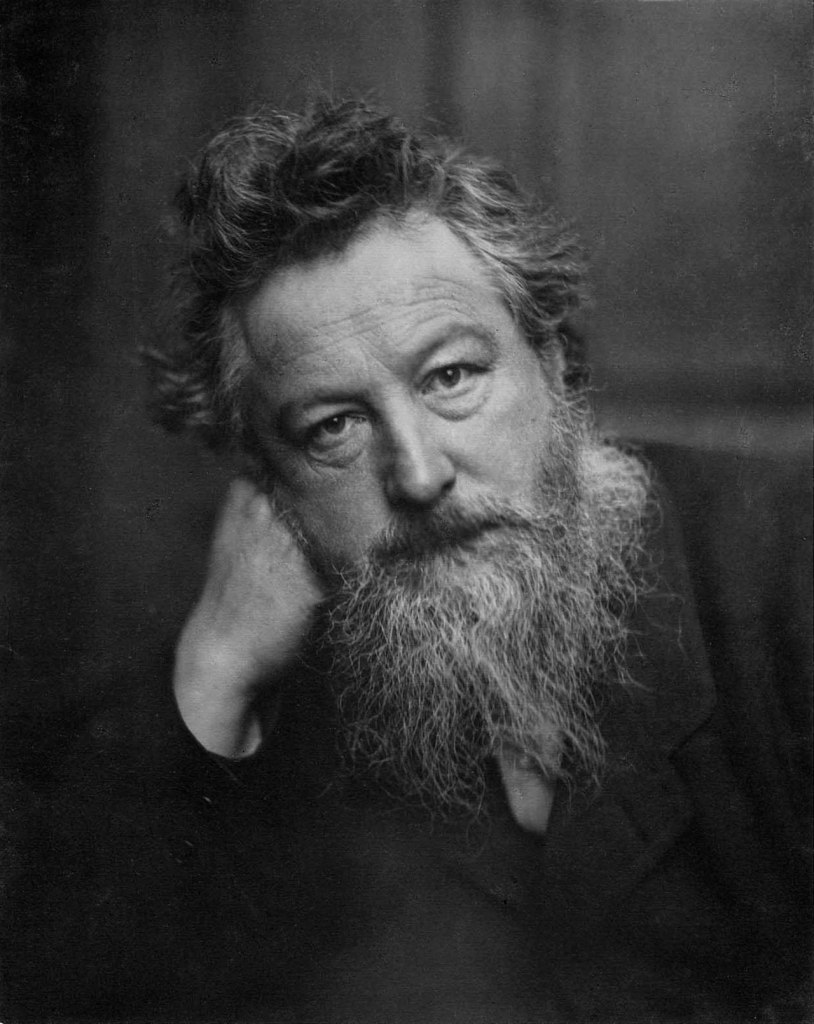
William Morris
Retrieved from: https://en.wikipedia.org/wiki/William_Morris#/media/File:William_Morris_age_53.jpg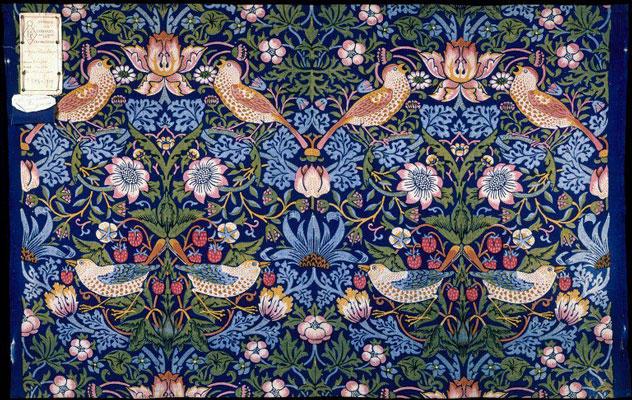
Morris, W. (1883) Strawberry Thief (textile design)
Retrieved from: https://www.theartstory.org/artist/morris-william/artworks/
Gertrude Jekyll 1843-1932
- English landscape architect
- Advocate of a ‘natural’ garden influenced by Arts and Craft Movement
- Mainly a painter until 1891 when she began to lose vision
- Taste for simplicity and orderly disorder of cottage gardens
- Worked with William Robinson and wrote a number of successful books together
- Designed gardens with Edwin Lutyens which is considered to be her greatest contribution
- Produced a new style pf architectural gardens where Lutyens provided an architectural skeleton and Jekyll softened and added rhythm with colour and form
- Each influenced the other and together produced around 100 designs
- Firm principles on garden design and planting schemes
- Believed in understanding the beauty of a natural landscape
- Taught the value of ‘ordinary’ plants such as Hastas, Bergenias, Lavender and Roses
- Many gardeners take aspects of Jekylls gardens to add to their own gardens
- Best known for herbaceous borders with colour schemes going cold (whites/blues) to hot (oranges/reds) and back to cold again (she had an eye for colour and contrasting plant texture)
- Due to her diminished vision she saw the colours more as a faded or blurred effect and not with clarity
- Used plants in a range of settings always trying for a natural effect
- Gardens treated as a whole with sections in it, each plant needed to complement the others
- Completed around 350 commissions in England and America
- Many writings both books and articles
- Gardens open to the public: Hestercombe, Barrington Court and Upton Grey (and others)
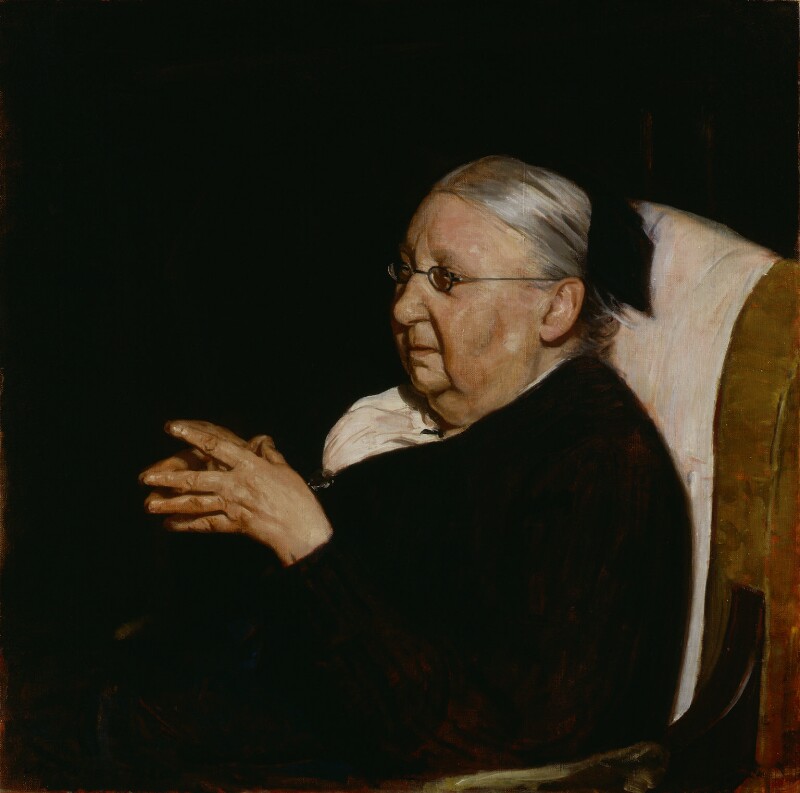
Gertrude Jekyll
Retrieved from: https://en.wikipedia.org/wiki/Gertrude_Jekyll#/media/File:Gertrude_Jekyll_portrait.jpg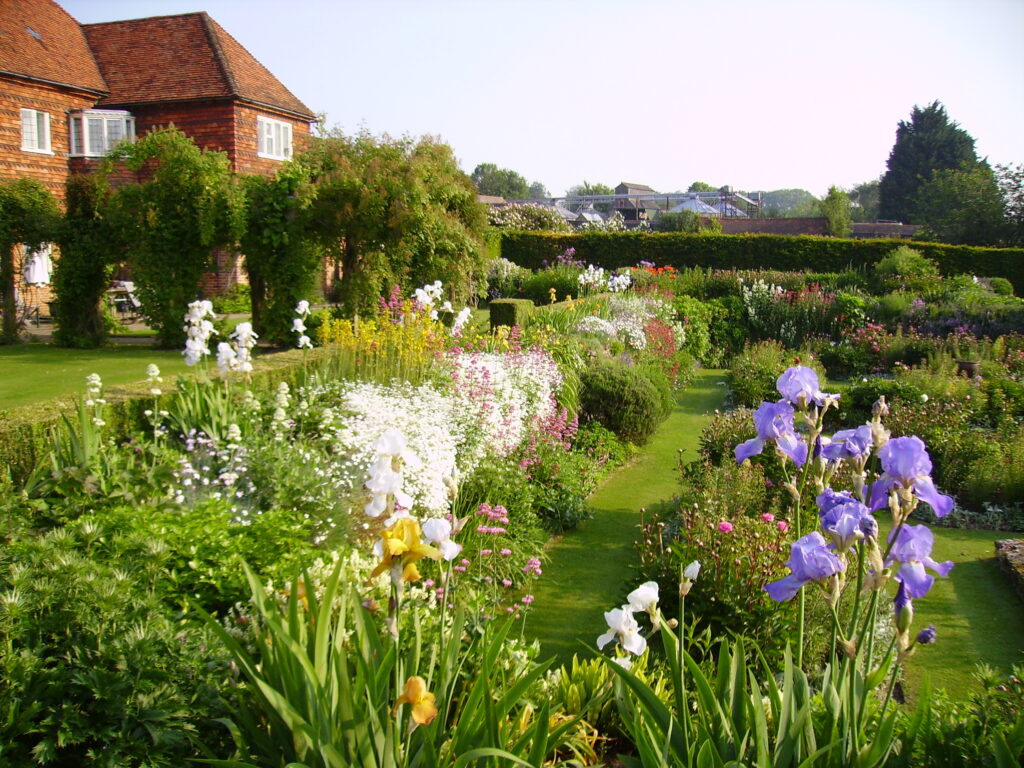
The Manor House, Upton Grey
Retrieved from: https://gertrudejekyllgarden.co.uk/
Sir Edwin Lutyens 1869-1944
- English Architect
- Worked on private houses, government buildings, offices, new towns and museums worldwide
- Embraced rustic and vernacular style
- Skilled at interiors and exteriors, large or small jobs
- Selected by Commonwealth War Graves Commission he built and designed war memorials, tombstones and graveyards (much needed after WWI)
- Designed Cenotaph at Whitehall, London (1919-1920), The Great War Stone (1919) and military cemeteries in France
- Project for Roman Catholic Cathedral in Liverpool was unfinished when he died
- Designed Cenotaph at Whitehall, London (1919-1920), The Great War Stone (1919) and military cemeteries in France
- Met Gertrude Jekyll in 1889 and began a long collaboration
- She influenced his early works in Vernacular Surrey style and introduced him to many of his early clients
- Helped Lutyens gain garden design skills which in turn enhanced his architectural creativity
- Munstead Wood, Surrey (1896)- Gertrude Jekylls house – first showed his qualities as a designer and made his reputation (sweeping roof, high buttressed chimneys, offset small doorways with long strips of windows)
- Followed with a series of country houses where he adapted styles of the past to contemporary domestic architecture
- Lutyens used structural architecture (stairs, terraces, paths and walls) combined with informal planting
- Responsible for the British Pavilion at Paris Exhibition in 1900 (worked with Herbert Jekyll, Gertrudes brother)
- Well known for his planning of New Delhi and the Viceroys house in 1912
- Garden city built in series of hexagons separated by wide tree lined avenues
- Viceroy house combined aspects of classical architecture with features of Indian decoration (1913-1930)
- Knighted in 1918
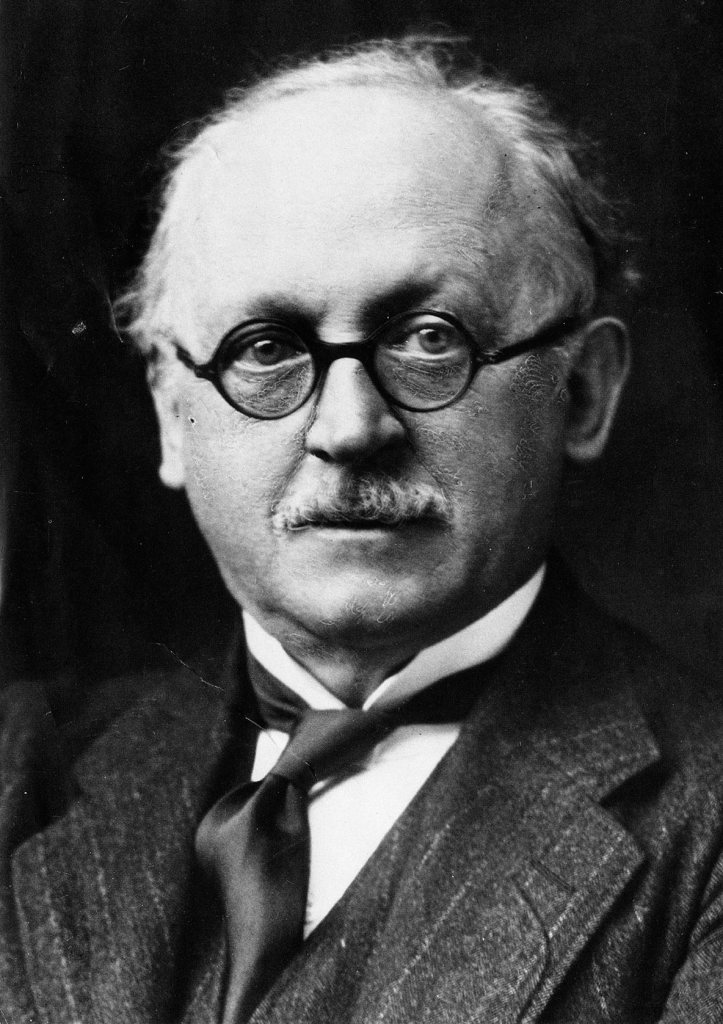
Sir Edwin Lutyens
Retrieved from: https://www.lutyenstrust.org.uk/about-lutyens/biography/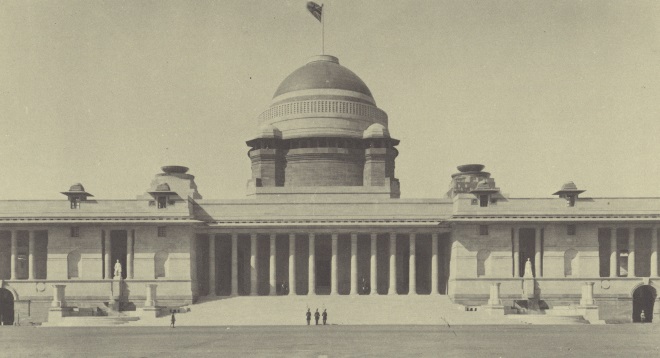
Viceroy’s House, New Delhi
Retrieved from: https://www.architectural-review.com/essays/the-rise-and-fall-and-rise-of-edwin-lutyens
Lancelot Brown 1715-1783
- English landscape architect
- Known as Capability Brown fro saying properties has capabilities
- Remembered as one of Englands greatest gardeners
- Designed over 170 parks
- Principles of comfort and elegance
- Garden had to work and provide for the house but had to be elegant
- Used lakes at different levels to create the illusion of large bodies of water like rivers through parkland
- Style of smooth, undulating grass straight to the house, sunken fences (to not interrupt the view)
- Landscapes on a large scale with gardens, parklands, planting woods and farms linked by carriage drives or ridings far from the main house
- Would often move groups of trees to re-arrange the view to how they wanted
- Whole towns were moved to accommodate large gardens
- Produced architectural drawings, based off of his impression of English country houses (of which he designed the gardens – this allowed him to make the whole visual element)
- Gothic stable blocks, decorative out buildings, arches and garden features were in many of his designs
- Worked under William Kent in 1741 (Founder of the new English style of landscape gardens) at Stowe, Buckinghamshire
- Appointed head gardener in 1742 (aged 26) until 1750
- Made Grecian valley at Stowe
- Accepted freelance commission work and became known as a landscape gardener (English Landscape Garden or picturesque style)
- Became sought after by ‘landed families’ (landowners who could live from rental income alone)
- Appointed by King George III to be Master gardener at Hampton Court Palace in 1764
- Browns work is constantly reassessed and critiqued but still over 150 or around 260 landscapes can be seen
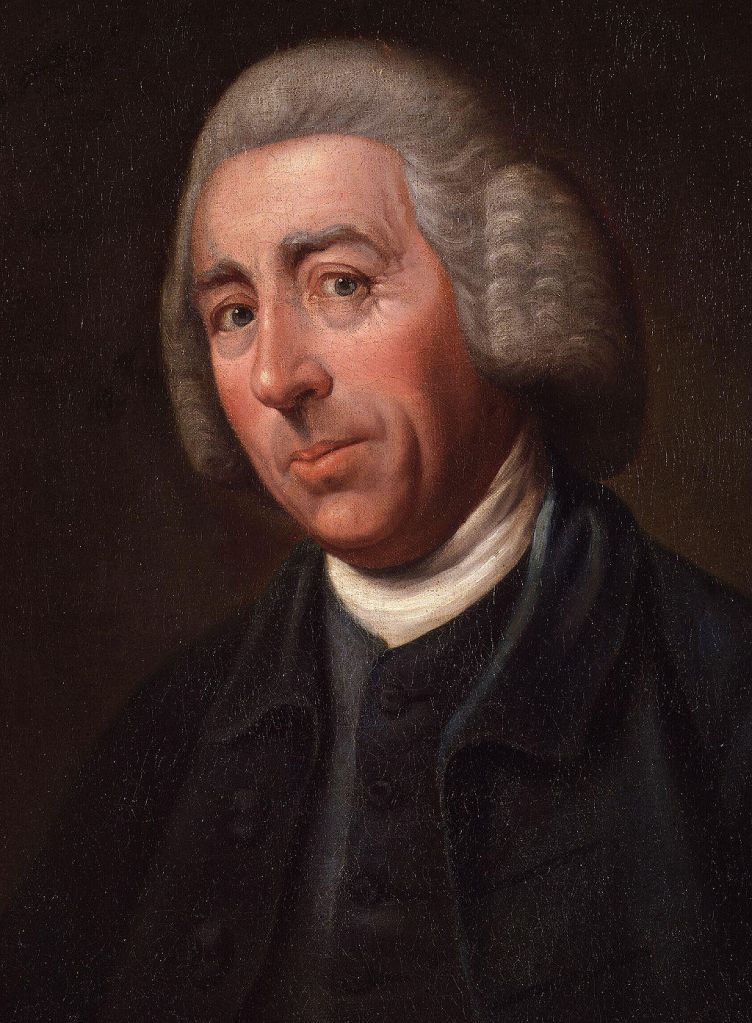
Dance, N. (1770’s) Lancelot ‘Capability’ Brown
Retrieved from: https://en.wikipedia.org/wiki/Capability_Brown#/media/File:Lancelot_(‘Capability’)Brown_by_Nathaniel_Dance,(later_Sir_Nathaniel_Dance-Holland,_Bt)_cropped.jpg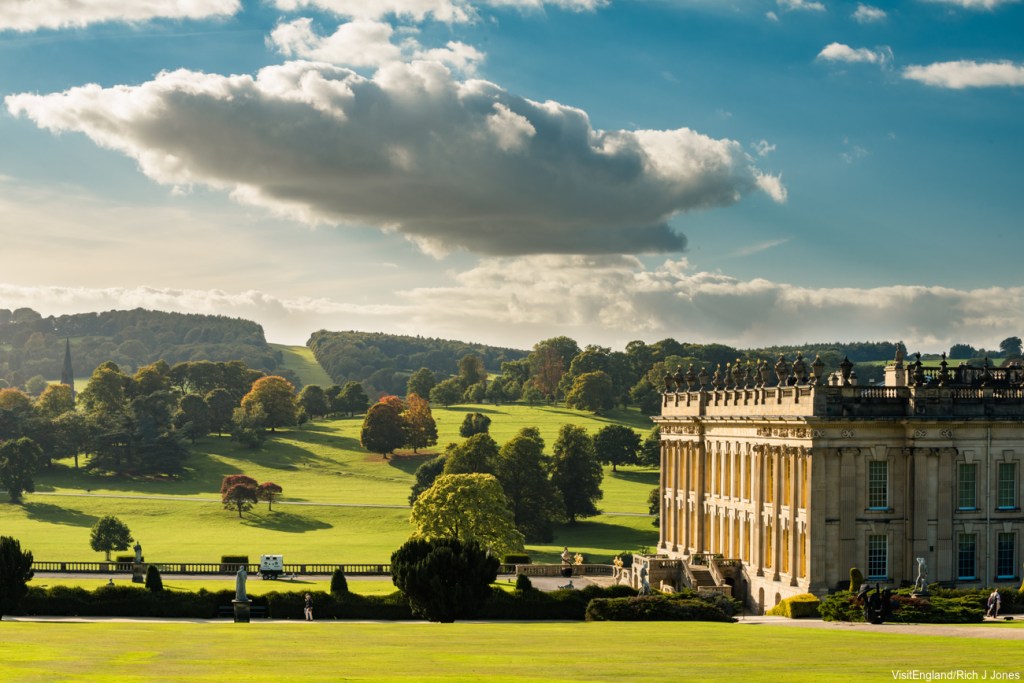
View over the historic Chatsworth House, Derbyshire, England. The house sits in parkland laid out by Capability Brown.
Retrieved from: https://www.britain-magazine.com/features/history/capability-brown-englands-gardens/
 Spatial Design


Leave a comment